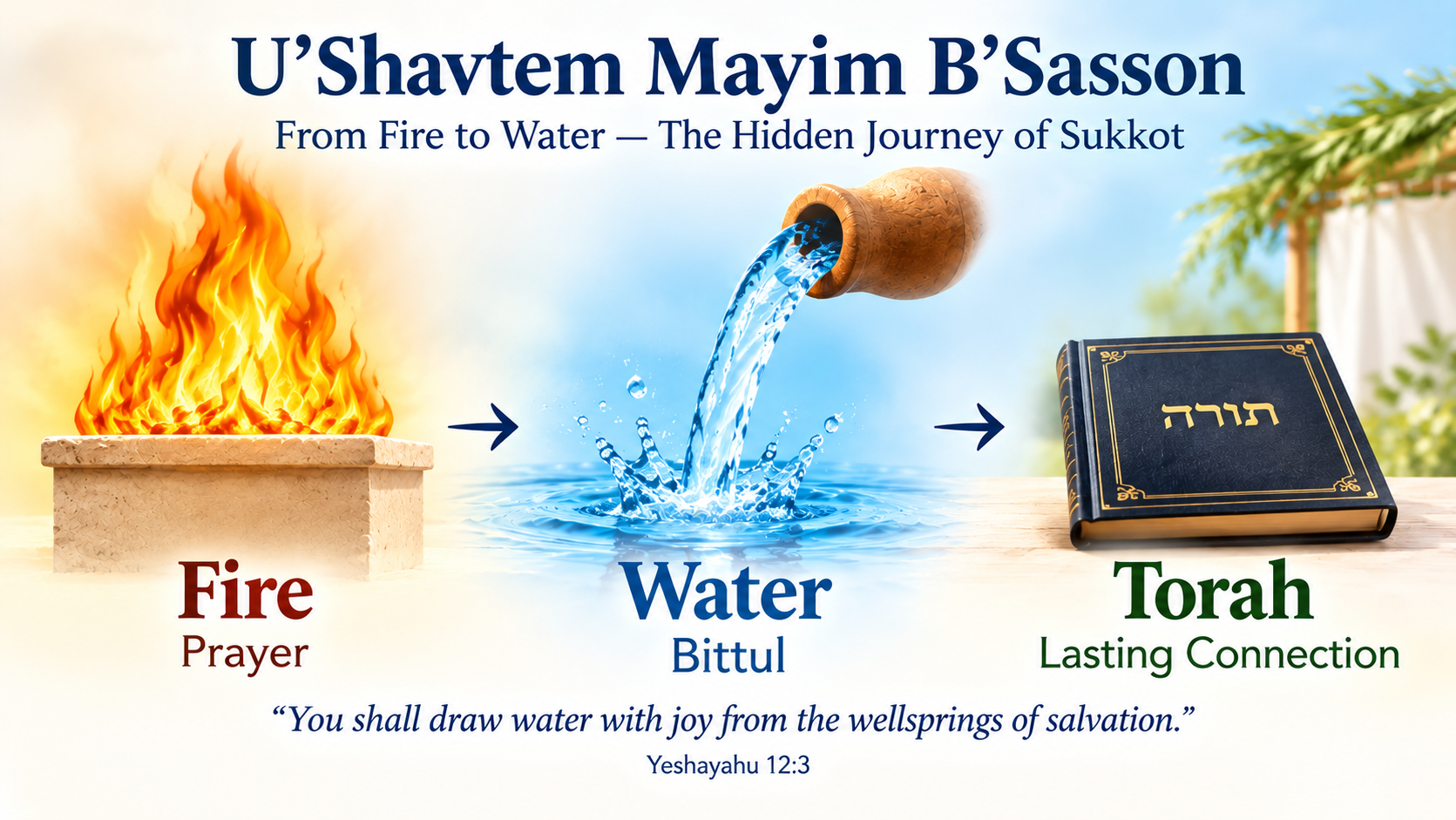
This Chassidic discourse explains the spiritual meaning of the water libation of Sukkot, the fire on the Temple altar, and Shemini Atzeret, and how these Temple services can be experienced today through prayer, self-reflection, and Torah study.
1. The “fire” of prayer
When the Temple existed, sacrifices were placed on the altar and consumed by a heavenly fire. Today, the human heart is compared to the altar, and prayer replaces the Temple sacrifices.
There are two dimensions of the heart:
- The external heart — where a person's natural love for Hashem can become emotionally expressed.
- The inner heart — a much deeper level of attachment and self-nullification.
During prayer, especially Pesukei DeZimrah, a person should awaken his natural love for Hashem until it burns like a fire. This spiritual fire should consume the “foreign fires” within a person—material desires, anxieties, ego, and distractions that pull him away from Hashem.
One important example is worry about livelihood. Earning a living is not itself the problem; the problem is excessive anxiety and preoccupation with it. Prayer is meant to “burn away” that anxiety and restore a person's awareness that his life ultimately depends upon Hashem.
2. “Bring fire from below”
Although a heavenly fire came down onto the Temple altar, the Torah also commanded the Jews to bring a fire from below.
The lesson is that a person must make his own effort first.
A person should honestly examine himself and recognize how far he may have drifted from Hashem. This is called חשבון הנפש — an honest accounting of one's spiritual state.
This humility is symbolized by the statement of Avraham:
“I am dust and ashes.”
When a person becomes humble and recognizes his own shortcomings, this creates the spiritual “kindling” that allows a higher love of Hashem to be revealed.
The process is compared to planting a seed. The soil must first be broken up and softened before the seed can grow.
Similarly:
Self-examination → humility → spiritual awakening → revelation of Divine love.
This is especially connected with the Ten Days of Repentance, Yom Kippur, and then Sukkot.
3. From “fire” to “water”
The discourse then introduces a higher spiritual level.
Fire represents passionate love of Hashem.
Water represents a deeper level of Divine awareness and bittul (self-nullification).
Fire is passionate and outwardly expressive. Water cools and settles the fire.
The example given is a child who misses his father. When he is far away, he cries, “Father! Father!” His love is expressed intensely.
But when he is actually sitting next to his father, the love is so deep that it no longer needs to be expressed outwardly. It exists quietly within him.
That is the difference between the spiritual “fire” of passionate prayer and the “water” of profound bittul.
4. Shemoneh Esrei — standing before the King
This is why the structure of prayer progresses from emotional excitement to the quietness of Shemoneh Esrei.
During Pesukei DeZimrah, a person awakens his love for Hashem.
But during Shemoneh Esrei, he should feel as though he is actually standing before Hashem.
Therefore, Shemoneh Esrei is said quietly and includes bowing and expressions of complete submission.
The goal is not merely to become emotionally excited about Hashem, but to reach a state in which one's entire identity is surrendered to Him.
5. Torah preserves the inspiration of prayer
There is a problem, however: after prayer ends, a person can quickly return to his ordinary state.
The discourse therefore explains that Torah study is what preserves the spiritual state achieved during prayer.
Even though Torah discusses seemingly physical subjects—agriculture, business, damages, holidays, property, etc.—the Torah is ultimately Divine wisdom.
When a person studies Torah with the proper attitude, he becomes completely absorbed in Divine wisdom.
Thus:
Prayer creates the spiritual awareness.
Torah makes that awareness lasting.
This is the meaning of “Shemini Atzeret” — עצרת, which means to stop, retain, or hold onto something.
Shemini Atzeret represents the ability to retain and internalize the spiritual “water” that was revealed during Sukkot, rather than allowing it to disappear once the holiday and prayer are over.
6. “You shall draw water with joy”
The famous verse says:
ושאבתם מים בששון ממעיני הישועה
“You shall draw water with joy from the wellsprings of salvation.”
The “water” represents the deeper experience of bittul and attachment to Hashem.
But the Rebbe emphasizes the word “wellsprings” — מעייני.
A wellspring comes from something hidden deep underground. You don't see the source itself—you see the water emerging from it.
Likewise, the deepest connection to Hashem comes from reaching into the deepest part of the soul.
7. Two “wellsprings”
The discourse identifies two important sources:
1. “My soul is like dust to everyone” — ונפשי כעפר לכל תהיה
A person must develop genuine humility and recognize that his ego should not stand between himself and Hashem.
2. Torah study — פתח לבי בתורתך
A person must immerse himself deeply in Torah, even when the Torah is discussing ordinary physical matters.
These two things work together:
Humility + Torah = a wellspring of Divine awareness.
This explains the prayer:
“Let my soul be like dust to everyone; open my heart to Your Torah.”
The two requests are connected. The more a person removes his ego and makes himself receptive, the more deeply Torah can enter him.
The overall message
The discourse presents a three-stage spiritual journey:
🔥 Fire — Prayer
Awaken your natural love for Hashem and burn away distractions, ego, and material anxieties.
💧 Water — Bittul
Move beyond emotional excitement to a quiet, profound awareness that there is nothing separate from Hashem.
🌱 Wellspring — Torah
Dig beneath the surface through humility and deep Torah study so that this Divine awareness becomes something internal and lasting.
And this is the progression of Sukkot → Shemini Atzeret:
Fire → Water → Internalization
The ultimate goal is not simply to have a powerful spiritual experience during prayer or a holiday. The goal is to draw that experience deep into oneself so that it remains throughout the entire year.
One-sentence Chassidic takeaway
Prayer awakens the fire of love for Hashem; humility and bittul transform that fire into the cooling waters of Divine awareness; and Torah study allows those “living waters” to become permanently rooted within the person.