English Summary
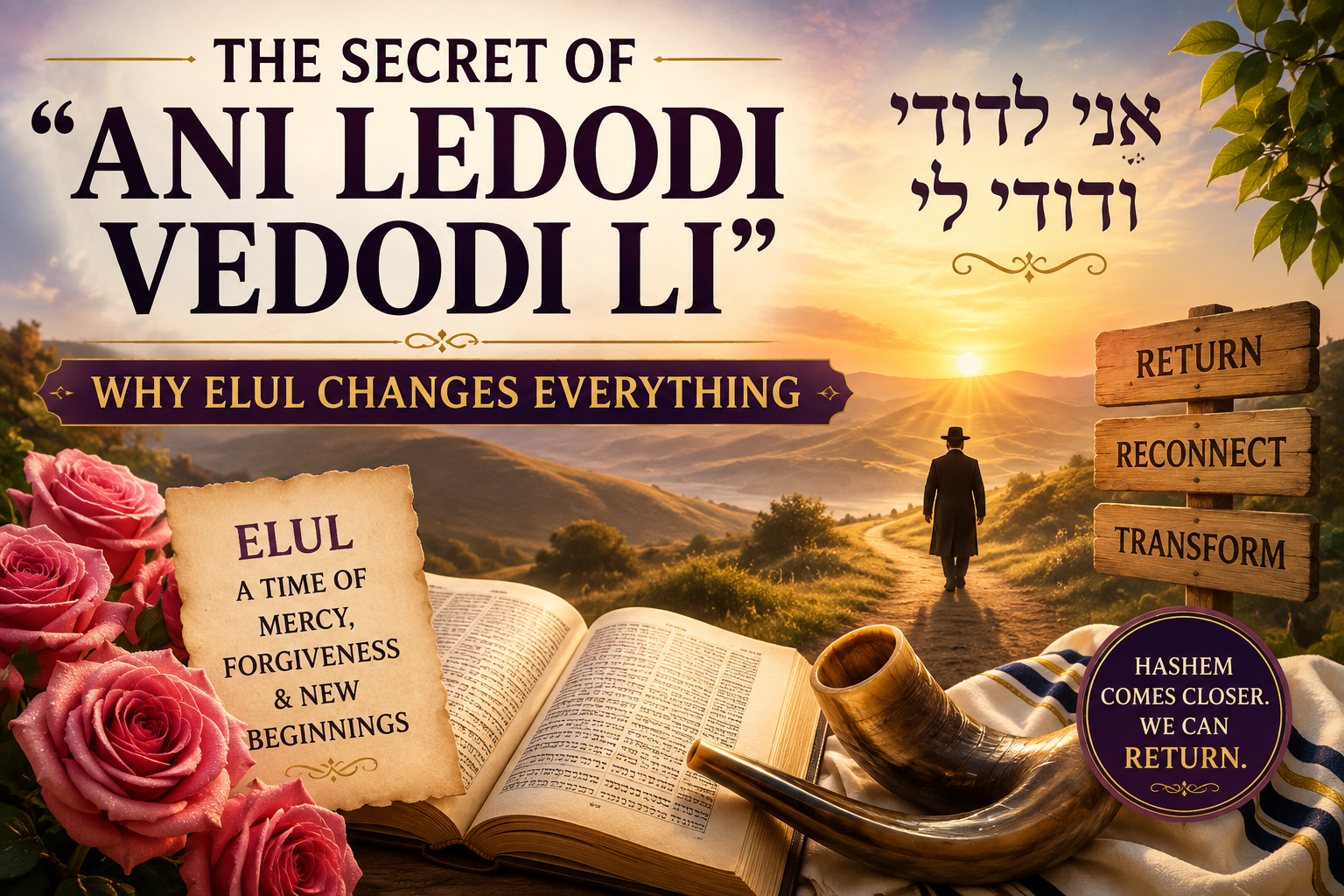
This Chassidic discourse explains the deeper meaning of the verse "Ani LeDodi VeDodi Li" — "I am my Beloved's and my Beloved is mine", whose initials spell Elul. The central theme is that the month of Elul is a special time when G-d makes it spiritually easier for a person to do teshuvah (return/repentance).
The verse continues with "HaRo'eh BaShoshanim" — "He shepherds among the roses." The word shoshanim (roses) is understood mystically as referring to the Thirteen Attributes of Divine MercyThe thirteen attributes through which G-d reveals His mercy and forgiveness, especially during the month of Elul.
These attributes are especially revealed during Elul because the forty days from Rosh Chodesh Elul through Yom Kippur correspond to the forty days Moshe spent on Mount Sinai receiving the second Tablets. Those forty days were a period of Divine favor and forgiveness.
Therefore, Elul is not merely a time when we are expected to repent; G-d provides special assistance from above to enable us to repent.
What Does “Teshuvah” Really Mean?
Teshuvah does not only mean repenting for sins.
A person is supposed to be involved in teshuvahReturn and repentance; turning back toward G-d and changing direction throughout his entire life. At its deeper level, teshuvah means returning from one's previous spiritual state and changing direction—moving closer to G-d.
The discourse then explores the famous Talmudic debate:
“Talmud is greater” — vs — “Action is greater”
The conclusion is that Torah study is greater because it leads to action.
To understand this, the discourse explains two ways in which Divine energy exists in creation.
Mimalei Kol Almin — Divine Energy Within Creation
Mimalei Kol Almin“That which fills all worlds” — the Divine energy that is revealed within creation, limited and differentiated according to each recipient means that G-d's Divine energy is within creation, giving each creature the particular life-force it needs.
Just as:
An inanimate object has a very limited vitality.
A plant has more.
An animal has more.
A human being has an even higher level.
So too, in the spiritual worlds there are different levels of Divine revelation.
This Divine energy is limited and differentiated according to the recipient.
This corresponds to Mimalei Kol Almin, the Divine energy that is revealed within creation.
Sovev Kol Almin — Divine Energy Beyond Creation
There is another, much higher level called Sovev Kol Almin“That which surrounds all worlds” — a Divine revelation that is above the limitations and categories of creation—literally, “that which surrounds all worlds.”
This does not mean that G-d is physically outside the world. Rather, it means that this Divine revelation is above the limitations and categories of creation.
Because it is not revealed according to the limitations of each individual creation, it is equally present everywhere.
This is the deeper meaning of:
The “filling” refers to the inner Divine vitality, while the higher level of Divine presence transcends the distinctions between the different worlds.
Torah and Mitzvos Connect to These Two Levels
The discourse explains a profound distinction:
So Why Is Torah Greater Than Action?
If mitzvos reach a higher level, why did the Sages conclude that Torah study is greater?
Because Torah is the bridge that enables mitzvos to happen properly.
A person cannot properly perform mitzvos without first learning what to do.
Torah takes the Divine potential that is hidden in thought and brings it into conscious understanding and ultimately into action.
Torah is greater because it leads to action.
Why Can Teshuvah Happen Specifically in This World?
The verse says:
This world is called the world of action.
In the World to Come, a person experiences Divine revelation according to the spiritual level he has already achieved. There is much less opportunity to fundamentally transform oneself.
But this physical world contains the hidden influence of Sovev Kol Almin, the transcendent Divine energy.
Therefore, even someone who has fallen extremely far can suddenly transform himself and become a completely different person.
This is the unique power of teshuvah in this world.
That is why the Sages say that one moment of teshuvah and good deeds in this world is greater than all of the life of the World to Come.
Why Did the Soul Come Down Into a Physical Body?
The soul descended into this physical world for a specific mission:
to transform the physical and elevate it to holiness.
Every person is given a particular amount of time because his soul has particular things it needs to accomplish and refine.
Every day provides another opportunity to transform some part of the world—or some part of oneself—from darkness to holiness.
When a person sins, however, he creates a spiritual deficiency because the Divine energy that could have been revealed through the mitzvah was not revealed.
Simply being forgiven does not necessarily repair everything that was lost.
That is where teshuvah comes in.
The Deeper Meaning of “Complete Teshuvah”
We ask:
The word “complete” is extremely significant.
The deepest form of teshuvah reaches beyond the ordinary Divine revelation of Sovev Kol Almin and reaches toward G-d's very Essence.
This allows a person not merely to be forgiven but to repair the spiritual deficiencies created by the past.
But how can an ordinary human being awaken such an incredibly high level?
G-d Himself helps the person do it.
This is the special revelation of the Thirteen Attributes of Mercy during Elul.
What Makes Elul Special?
During the rest of the year, the Thirteen Attributes of Mercy can also be invoked. But the revelation in Elul is different.
During Elul, the Divine mercy is directed toward the life of the soul—helping a person awaken spiritually and develop the strength to do teshuvah.
This is the meaning of:
G-d is like a shepherd who feeds and sustains the Jewish soul with the spiritual nourishment necessary to return to Him.
“Shoshanim” and “Shonim” — Roses and Torah Learners
The discourse then gives another interpretation:
The Sages say, “Do not read shoshanim (roses), but shonim (those who study/repeat Torah).”
Thus, the verse contains two ideas:
This means that complete teshuvah requires both dimensions:
1. The higher Divine mercy from above, which gives a person the power to transform himself.
2. Torah, which gives that transformation structure, understanding, and practical expression.
The Overall Message of the Discourse
The central message is that Elul is not simply a month when we are supposed to work harder at repentance. It is a month when G-d comes closer to us and gives us special spiritual assistance to accomplish something that would otherwise be extremely difficult.
The order is:
The deepest idea is that teshuvah is more than correcting mistakes. It is the power to completely change one's spiritual identity because, in this physical world, the transcendent aspect of G-dliness is accessible.
That is why “Ani LeDodi VeDodi Li” is the perfect description of Elul:
The person turns toward G-d—and at the same time, G-d turns toward the person and gives him the strength to return.